Who Wants To Be A Millionaire has been a phenomenal world wide success since its debut in 1998. In that time around a hundred people in a few dozen countries have earned the top prize.
However, with every high there are a bunch of lows. Here are some of the worst of the worst.
The $100 question - Homeowners buy surge protectors to protect their possessions from unexpected surges of what?
$200 question - What punctuation mark is used to introduce a list of items?
From France, a classic. He goes to the audience for help with the question. What is going on in their schools? The question that stumped France's best and brightest?
What rotates around the Earth?
A. The Moon B. The Sun C. Mars D. Venus
Another non-hundred dollaraire - Which of these phrases is a common way of saying "I can't take it anymore"?
(Nothing Follows)

Monday, 10 December 2007


Sunday, 9 December 2007
Sunday night Aussie rock
The Lime Spiders were formed in 1979 by Mick Blood, who cites their influences as being 1960s garage bands with psychedelic rock, together with Darryl Mather, Eric Grothe and Dave Guest. The band's name is based on a non-alcoholic Australian cocktail (a combination of vanilla ice cream and lime soda).
These guys are a great band and have reformed a number of times over the years. They were probably a bit raw to have great commercial success but bands like the Lime Spiders are what makes Australia's pubs and clubs such great places to go on a Friday or Saturday night.
Weirdo Libido
My Favourite Room
(Nothing Follows)
These guys are a great band and have reformed a number of times over the years. They were probably a bit raw to have great commercial success but bands like the Lime Spiders are what makes Australia's pubs and clubs such great places to go on a Friday or Saturday night.
Weirdo Libido
My Favourite Room
(Nothing Follows)
Saturday, 8 December 2007
New Australian government ratifies Kyoto then pulls handbrake
When the first action taken by the new Labor government was to ratify Kyoto I wondered whether it was an ominous sign of the left's compulsion for symbolism over results.
As I've commented previously, leadership tends to change people in positive ways and it's always wise to let some time go by before passing judgement. Who would have thought, in 1996, that John Howard would become the political giant that he did?
Labor's campaign tactic on the environment made ratifying Kyoto the central theme and in doing so ensured that not only did it not lose votes to the Greens but actually picked up a few from them. Now that they've fulfilled their obligation to ratification they need to work on how to fulfil their obligation to economic conservatism - something I'll believe when I see it but, as commented above, it's always wise to give things time rather than rush to judgement - which comes in the form of the Garnaut report. The report is not due out until next year and allows Labor to not commit to anything in Bali; the best of both worlds.
As I've commented previously, leadership tends to change people in positive ways and it's always wise to let some time go by before passing judgement. Who would have thought, in 1996, that John Howard would become the political giant that he did?
Labor's campaign tactic on the environment made ratifying Kyoto the central theme and in doing so ensured that not only did it not lose votes to the Greens but actually picked up a few from them. Now that they've fulfilled their obligation to ratification they need to work on how to fulfil their obligation to economic conservatism - something I'll believe when I see it but, as commented above, it's always wise to give things time rather than rush to judgement - which comes in the form of the Garnaut report. The report is not due out until next year and allows Labor to not commit to anything in Bali; the best of both worlds.
PRIME Minister Kevin Rudd last night did an about-face on deep cuts to greenhouse gas emissions, days after Australia's delegation backed the plan at the climate talks in Bali.(Nothing Follows)
A government representative at the talks this week said Australia backed a 25-40 per cent cut on 1990 emission levels by 2020.
But after warnings it would lead to huge rises in electricity prices, Mr Rudd said the Government would not support the target.
The repudiation of the delegate's position represents the first stumble by the new Government's in its approach to climate change.
Mr Rudd said he supported a longer-term greenhouse emissions cut of 60 per cent of 2000 levels by 2050.
But the Government would not set medium-term targets until a report by economist Ross Garnaut was completed next year.
"I think speculation on individual numbers prior to that is not productive and I would suggest it would be better for all concerned if we waited for the outcome of that properly-deliberated document," Mr Rudd said.
The electricity industry yesterday warned it may not be able to meet growing consumer demand and comply with the 2020 target.
Energy Supply Association of Australia chief executive Brad Page said a 17 per cent power price rise in Victoria would seem "pretty modest" compared with the cost of complying with the target.
An ESAA report released this year found cutting carbon emissions by 30 per cent of 2000 levels by 2030 wold push up power costs by 30 per cent.
Mr Page said the cost of meeting the higher target by 2020 would be much more as low-cost, green-generation technology would not be available for more than 10 years.
"You are dependent on yet-to-be delivered technology," he said.
"The community needs to be aware cuts of this magnitude will come at considerable cost and it's difficult to know how exactly it will be delivered."
Opposition Leader Brendan Nelson said the suggested cuts would have "devastating impact" on Australia's economic development.
"It will have serious consequences for electricity bills and many other burdens borne by working families in day-to-day life, and pensioners," Dr Nelson said.
Greenpeace campaigner Steven Campbell said Australia should slash carbon emissions by 20 to 40 per cent of 1990 levels by 2020.
"If we want to keep global warming below 2C then these are the targets we need," Mr Campbell said.
A team of 212 climate change experts from more than 20 countries yesterday called for a 50 per cent cut in greenhouse pollution by 2050.
Thursday, 6 December 2007
Do the Climate Faithful understand they're supporting Marxist policies?
It's axiomatic that belief in anthropogenic global warming is a completely political position, which is why when people like me actually demonstrate the non-science that supposedly supports the argument the Climate Faithful come back with all sorts of ad hominem attacks, unsupported, unscientific drivel and policy positions based on the wildly misanthropic precautionary principle.
I have posted on numerous occasions about one of the elephants in the room of the Climate Faithful being the take over of the environmental movement by those on the extreme political left. That's why Big Green members are referred to as watermelons - green on the outside, red on the inside.
I sometimes wonder whether the politically naive, feel good, centre-left voter who supports environmental causes but for whom Marxist theology is anathema actually understand who's driving the old Climate Change Bus.
Here's Phil Valentine's latest article, supporting the same position:
I have posted on numerous occasions about one of the elephants in the room of the Climate Faithful being the take over of the environmental movement by those on the extreme political left. That's why Big Green members are referred to as watermelons - green on the outside, red on the inside.
I sometimes wonder whether the politically naive, feel good, centre-left voter who supports environmental causes but for whom Marxist theology is anathema actually understand who's driving the old Climate Change Bus.
Here's Phil Valentine's latest article, supporting the same position:
U.N. scam shows Marxism at heart of warming movement(Nothing Follows)
Apparently, I hit a nerve with a column I wrote a couple of weeks ago on global warming. Many of you took umbrage with my daring to connect the global warming movement to Marxism. Don't get me wrong. I do not believe everyone involved in the global warming movement subscribes to Karl Marx's philosophy. However, make no mistake about it. Those at the epicenter of this movement have ulterior motives, many of them socialist or even Marxist. What I wrote that caused such a fuss was that global warming is being used as a template to rob from the rich nations and give to the poor ones.
Right on cue, the United Nations issued a report last week that made my point. The headline from The Associated Press: "Poor will need $86b from rich to cope, UN says." Ah, here we go.
The report says the rich nations will need to cough up $86 billion per year by 2015 to "strengthen the capacity of vulnerable people." Half the money, ostensibly, would go toward "climate-proofing" developing nations' infrastructure, whatever that means, while the other half would help the poor cope with related risks. Of course, the ambiguity is on purpose. You and I know that the bulk of this money will be skimmed off by tinhorn dictators, the same rabble that runs the U.N.
The report was conveniently released just a week before the world's nations gather in Bali to hammer out yet another Kyoto-style climate treaty. This will be another attempt to shame the developed world into turning over their hard-earned gold and silver to the rest of the world.
"In Bali, we are going to very seriously discuss the price rich countries have to pay so that poorer countries can preserve their forests," said Brazil's leftist president, Luiz Inacio Lula da Silva. Ironically, Brazil is one of the world's biggest emitters of so-called greenhouse gases. They're mowing down the rain forest to beat the band, and now they and the United Nations want us to pay them to stop destroying it. Makes perfect sense, doesn't it?
The Bali bailout comes at a time when the Energy Information Administration reports that U.S. carbon dioxide emissions are actually down 1.5 percent. Don't count on that getting much press at the conference. We're also coming off a tame hurricane season, despite the loud rantings from the global-warming crowd that this would be one of the worst seasons on record. Al Gore said in September 2005, "Now, the scientific community is warning us that the average hurricane will continue to get stronger because of global warming." We're coming off two relatively tame hurricane seasons in a row. Where are all these stronger hurricanes Gore was warning about? Does that mean he's now willing to admit he was wrong? Probably not.
Actually, the only hurricane-force winds clocked in these parts came from the wake of Al Gore's automobile. According to a report by NewsChannel5, ole Spotted Al was clocked doing a not-so-fuel-efficient 95 mph last year. At least, he'll be able to speed in style. The Tennessean's own Beverly Keel reported that Mr. Gore was spotted purchasing a Lexus LS 600h, their new hybrid model. According to a New York Times review, Al's new ride gets a whopping 21 mpg — 1 mpg less than the non-hybrid version. Atta way to save the planet, Al. Maybe there's an opening for you at the U.N.
Wednesday, 5 December 2007
Pluralism vs Multiculturalism
A lot has been made of the success of multiculturalism in Australia. We have vibrant communities of Greeks, Italians, Maltese, Polish, Finns and Vietnamese etc that have been attracted to this country over the last 50 or so years and in just a couple of generations these people have blended into the Australian population and enhanced Australia in the process.
The same can be said of the United States. The preamble to the Declaration of Independence includes the famous line "We hold these truths to be self-evident, that all men are created equal, that they are endowed, by their Creator, with certain unalienable Rights, that among these are Life, Liberty, and the pursuit of Happiness." That Americans have steadfastly worked towards upholding these truths in spite of an economic strength that could diminish their importance in the public psyche has been a powerfully attractive force for immigrants from all over the world.
As the inscription on the Statue Of Liberty states:
Equally, Australia's earliest settlers were, famously, convicts transported from the 'old country', many for the most trivial of crimes. That people from all walks of life worked together to create the great nation of Australia is one of the reasons that we have such a classless, fair-minded society today. This is also powerfully attractive for our immigrants.
Whereas Australia and America are truly egalitarian societies, open to anyone to enter and try their luck, European nations have been much less accommodating of their immigrant populations. Worse still, their increasing secularism has seen the values that made them once great be eroded away through the push to cultural relativism and equality of outcome with the obvious consequence of a spectacular failure to achieve truly multicultural societies.
So why have European nations failed so miserably where the US and Australia have been so successful?
The answer lies in a reinterpretation of multiculturalism by European elites that has seen it lose pluralism from its definition. Pluralism and multiculturalism are now completely different things, as I shall explain.
Melanie Phillips has a very important piece in which she talks about multiculturalism:
The key difference between pluralism and multiculturalism is this:
As Phillips points out, "...all minority values must have equal status to those of the majority." While the intellectual intention of multiculturalism is to raise the values of immigrant societies up to the norm of the host society what it achieves in practice is to dull, or completely remove, those exceptional values from each society thus creating what I refer to as lowest common denominaterism. All values must be equal and all outcomes must be equal.
Let me give a sideways example of how this equality of outcome and culture creates a lowest common denominator result and kills off exceptionalism.
Let's say that your humble blogger is entered in a 100m race against world record holder Asafa Powell. Equality of outcome dictates that I am to be given a dirty, great headstart due to my lower ability (brought about by years of self-indulgent beer drinking and pie eating that I'm sure Asafa would be jealous of) so the race starts with me at the 30m mark and Powell back at 100m. The gun goes off and Powell is away and racing, chasing the not inconsiderable lump of blogging humanity in the distance. I take off slowly, making sure not to do myself an injury in the first 10 metres of the race, build up a pretty impressive head of steam through the second 10 metres before hitting the wall at the 25 metre mark and staggering to the line completely spent after 30m, collapsing into the hands of my trainers and the welcome hose of an oxygen bottle. Powell, meanwhile, is running like a man who's seen a ghost and in a terrific burst over the last metres of the race manages to equal his 9.77s world record (!) and, amazingly, finish in a dead heat with me.
The question is - have I been raised to Powell's exceptional standard or has he been lowered to mine? The answer is obvious. Multiculturalism does not raise overall societal values, it lowers them to a standard below what existed previously. As an aside, affirmative action programs have the same effect, which is logical when you think about it.
Pluralism creates a society in which the best of all inputs continue to integrate and improve baseline values. Drawing again from Melanie Phillips:
It's possible that the success of Australia's and America's immigration policies has been due to the fact that we're both large countries, far away from our original European homes, which has meant that there has been greater opportunity for people to take advantage of our wide open spaces.
While European nations' socialist politicians preach cultural equality - in order to attract/buy the immigrant vote, as far as I can see - the reality is that they hold on to the cultural identities that have distinguished them from their physically close neighbours for a millennium or more and shut out immigrants completely.
How is it that the integration of France's Muslim population has been such a debacle? After all, this is the country whose official motto is "Liberté, Égalité, Fraternité" (Liberty, Equality, Fraternity). There are two issues at play here. Firstly, your average Frenchman is more than just a little bit racist, an unfortunate truth that needs to be recognised. Secondly, employment conditions in France are so restrictive that once an employee is hired into a full time position the employer is virtually stuck with them for life. In order to sack someone for even the most hopeless incompetence or laziness requires the employer to go to court and make their case. France has allowed millions upon millions of unskilled North African Muslims to settle in their country. How are they going to get a job when they have little relevant skill and an employer has such difficulty moving them on if they don't work out? Of course it's a debacle.
While France is in bad shape what's going on in the UK makes it look like a raging success. Returning again to Melanie Phillips:
You can't fight bad values with no values and, thus, extreme Islamist ideas have gained a strong foothold in the country, aided and abetted by a compliant, culturally-relativist, socialist elite.
European intellectuals look down their noses at Americans and, to a lesser extent, Australians but how does it come about that the Muslim population in the US has been able to integrate so seamlessly and enjoy the terrific economic success that sees them earn more than the average US worker?
Pluralism is now a completely different thing to multiculturalism. One is based on strong, positive values. The other is based on appeasing everyone with a lowest common denominator approach.
Which society would you rather live in?
The same can be said of the United States. The preamble to the Declaration of Independence includes the famous line "We hold these truths to be self-evident, that all men are created equal, that they are endowed, by their Creator, with certain unalienable Rights, that among these are Life, Liberty, and the pursuit of Happiness." That Americans have steadfastly worked towards upholding these truths in spite of an economic strength that could diminish their importance in the public psyche has been a powerfully attractive force for immigrants from all over the world.
As the inscription on the Statue Of Liberty states:
"Give me your tired, your poor,To immigrants arriving by ship into New York in years gone by the first glimpse they'd have of America would be the Statue Of Liberty, complete with shackles lying at her feet signifying freedom from oppression and tyranny. Stirring stuff, indeed. No wonder it's by far and away the most popular destination for immigrants.
Your huddled masses yearning to breathe free,
The wretched refuse of your teeming shore.
Send these, the homeless, tempest-tost to me,
I lift my lamp beside the golden door!"
Equally, Australia's earliest settlers were, famously, convicts transported from the 'old country', many for the most trivial of crimes. That people from all walks of life worked together to create the great nation of Australia is one of the reasons that we have such a classless, fair-minded society today. This is also powerfully attractive for our immigrants.
Whereas Australia and America are truly egalitarian societies, open to anyone to enter and try their luck, European nations have been much less accommodating of their immigrant populations. Worse still, their increasing secularism has seen the values that made them once great be eroded away through the push to cultural relativism and equality of outcome with the obvious consequence of a spectacular failure to achieve truly multicultural societies.
So why have European nations failed so miserably where the US and Australia have been so successful?
The answer lies in a reinterpretation of multiculturalism by European elites that has seen it lose pluralism from its definition. Pluralism and multiculturalism are now completely different things, as I shall explain.
Melanie Phillips has a very important piece in which she talks about multiculturalism:
Many people think multiculturalism just means showing respect and tolerance to other cultures and faiths. If that were so, it should be unarguable. We should all support respect and tolerance. But that's not what multiculturalism is at all. It holds that all minority values must have equal status to those of the majority. Any attempt to uphold majority values over minorities is a form of prejudice. That turns minorities into a cultural battering ram to destroy the very idea of being a majority culture at all. And so, since no culture can assert itself over any other, liberalism cannot assert itself as a dominant cultural force. Instead society must fragment into a kaleidoscope of equal — and opposing — values, and liberal values must give way to their opposite.Regular readers will recognise the similarity to what I have written previously.
The key difference between pluralism and multiculturalism is this:
- Pluralism is based on exceptional values as determined by the host society
- Multiculturalism is based on lowest common denominator values
As Phillips points out, "...all minority values must have equal status to those of the majority." While the intellectual intention of multiculturalism is to raise the values of immigrant societies up to the norm of the host society what it achieves in practice is to dull, or completely remove, those exceptional values from each society thus creating what I refer to as lowest common denominaterism. All values must be equal and all outcomes must be equal.
Let me give a sideways example of how this equality of outcome and culture creates a lowest common denominator result and kills off exceptionalism.
Let's say that your humble blogger is entered in a 100m race against world record holder Asafa Powell. Equality of outcome dictates that I am to be given a dirty, great headstart due to my lower ability (brought about by years of self-indulgent beer drinking and pie eating that I'm sure Asafa would be jealous of) so the race starts with me at the 30m mark and Powell back at 100m. The gun goes off and Powell is away and racing, chasing the not inconsiderable lump of blogging humanity in the distance. I take off slowly, making sure not to do myself an injury in the first 10 metres of the race, build up a pretty impressive head of steam through the second 10 metres before hitting the wall at the 25 metre mark and staggering to the line completely spent after 30m, collapsing into the hands of my trainers and the welcome hose of an oxygen bottle. Powell, meanwhile, is running like a man who's seen a ghost and in a terrific burst over the last metres of the race manages to equal his 9.77s world record (!) and, amazingly, finish in a dead heat with me.
The question is - have I been raised to Powell's exceptional standard or has he been lowered to mine? The answer is obvious. Multiculturalism does not raise overall societal values, it lowers them to a standard below what existed previously. As an aside, affirmative action programs have the same effect, which is logical when you think about it.
Pluralism creates a society in which the best of all inputs continue to integrate and improve baseline values. Drawing again from Melanie Phillips:
Pluralism allows for many different groupings but, unlike multiculturalism, does not try to impose one uniform status on all of them. It allows a thousand flowers to bloom, with minorities forming communities of faith, ethnicity or culture within a society — but under the overarching umbrella of a national identity to whose core values everyone signs up. It is only by having that overarching set of common values — monogamy, freedom of conscience, equal rights for women, freedom of expression — that a society coheres as a common project.Australians often refer to the success of multiculturalism in this country. In the new age definition of the term what we really now mean is that our success has been based on pluralism - getting the best out of everybody "...under the overarching umbrella of a national identity to whose core values everyone signs up" - rather than allowing the worst values of our immigrant populations to take root, such as has happened in Europe.
It's possible that the success of Australia's and America's immigration policies has been due to the fact that we're both large countries, far away from our original European homes, which has meant that there has been greater opportunity for people to take advantage of our wide open spaces.
While European nations' socialist politicians preach cultural equality - in order to attract/buy the immigrant vote, as far as I can see - the reality is that they hold on to the cultural identities that have distinguished them from their physically close neighbours for a millennium or more and shut out immigrants completely.
How is it that the integration of France's Muslim population has been such a debacle? After all, this is the country whose official motto is "Liberté, Égalité, Fraternité" (Liberty, Equality, Fraternity). There are two issues at play here. Firstly, your average Frenchman is more than just a little bit racist, an unfortunate truth that needs to be recognised. Secondly, employment conditions in France are so restrictive that once an employee is hired into a full time position the employer is virtually stuck with them for life. In order to sack someone for even the most hopeless incompetence or laziness requires the employer to go to court and make their case. France has allowed millions upon millions of unskilled North African Muslims to settle in their country. How are they going to get a job when they have little relevant skill and an employer has such difficulty moving them on if they don't work out? Of course it's a debacle.
While France is in bad shape what's going on in the UK makes it look like a raging success. Returning again to Melanie Phillips:
Many Muslims accept it (British standards), and manage to reconcile their faith with acknowledging that sharia law must give way to English law and values. But a third to a half of British Muslims want to live in Britain under sharia law, even though its precepts —such as polygamy, the subordination of women or the death penalty for apostates or gays —are totally inimical to western society. And multiculturalism gives them the muscle to insist that their practices must become mainstream.In a secular society the individual is left to choose what values they want that they deem important, creating a situation where no fundamental values exist that are worth fighting for. The UK is probably now the most secular society in Europe.
...Above all, Britain must not allow the encroachment of sharia. Yet it is paving the way for sharia. There are now areas of the country under the informal parallel jurisdiction of sharia law. A blind eye has been turned to honour killings, forced marriage and polygamy – now polygamous men settling in Britain are even receiving welfare benefits for their multiple wives. We have sharia-compliant mortgages; our tax authorities are considering recognising polygamy for inheritance tax purposes; and the government is encouraging London to become the global hub of Islamic banking, despite the fact that such arrangements will force those who make use of them to conform to sharia law.
You can't fight bad values with no values and, thus, extreme Islamist ideas have gained a strong foothold in the country, aided and abetted by a compliant, culturally-relativist, socialist elite.
European intellectuals look down their noses at Americans and, to a lesser extent, Australians but how does it come about that the Muslim population in the US has been able to integrate so seamlessly and enjoy the terrific economic success that sees them earn more than the average US worker?
Pluralism is now a completely different thing to multiculturalism. One is based on strong, positive values. The other is based on appeasing everyone with a lowest common denominator approach.
Which society would you rather live in?
Tuesday, 4 December 2007
Another nail banged into the Climate Coffin
Here's yet another nail in the coffin of CO2 climate change culpability. Unfortunately, our political masters seem intent on hamstringing the developed world's economies while letting China, India, Brazil and other economies off the hook at the upcoming Bali round of climate talks.
The Climate Faithful regularly question the credentials of those presenting research contrary to the so called 'consensus' that human created CO2 is the primary source of the current warming trend. What these people miss is that climate science is fundamentally a mathematical/ statistical analysis of climate data. Therefore, qualifications in those disciplines are mandatory in order to determine whether claims of correlation can be supported.
If school curricula were up to me then besides more rigorously testing reading, writing and arithmetic I'd include fundamental statistics and economics. With an understanding of those two latter disciplines people would be less easily fooled by trumped up claims presented as science such as CO2 as the cause of global warming or be sucked into the socialist ideas promoted by environmental groups, universities and sections of the mainstream media.
One often hears the phrase "correlation is not causation". To many people, when they see a graph in which two variables seem to track together they assume a relationship. It's a natural instinct and has been the subject of many studies. However, the graph could be the result of a deliberate falsification of the data. Statistical analysis is the method used to identify this falsification and it is an extremely important part of the validation process. Imagine where we'd be if we couldn't determine whether claims of mineral finds or financial market performance could not be verified.
At this point, it's worth reminding people what correlation means and what an r-squared statistical test achieves.
Correlation: In probability theory and statistics, correlation, also called correlation coefficient, indicates the strength and direction of a linear relationship between two random variables. In general statistical usage, correlation or co-relation refers to the departure of two variables from independence. In this broad sense there are several coefficients, measuring the degree of correlation, adapted to the nature of data.
Note that I'll use R2 to represent r-squared, as I don't have a superscript font available.
R-squared: In statistics, the coefficient of determination R2 is the proportion of variability in a data set that is accounted for by a statistical model...R2 is a statistic that will give some information about the goodness of fit of a model. In regression, the R2 coefficient of determination is a statistical measure of how well the regression line approximates the real data points. An R2 of 1.0 indicates that the regression line perfectly fits the data.
In summary, an R2 of 1 indicates 100% correlation and 0% indicates no correlation.
If I stopped now and took a survey of what the general population predicted the correlation between CO2 and temperature was over the 20th century then what would be the most popular range? I suspect it would be somewhere between 80% and 95%.
The following paper is from retired meteorologist Joseph D'Aleo, whose bio reads:
JOSEPH S. D'ALEO has 30 years experience in professional meteorology. He has BS and MS degrees in meteorology from the University of Wisconsin and did doctoral studies in meteorology at New York University. He taught meteorology at the college level for over eight years and was a cofounder and the first director of meteorology at the cable TV Weather Channel, a position he held for seven years. He joined Weather Services International (WSI) in 1989, where he was a marketing manager and chief meteorologist. Currently, he is senior editor (also known as "Dr. Dewpoint") for WSI's Intellicast Web site. D'Aleo is a Certified Consultant Meteorologist and was elected a Fellow of the American Meteorological Society. He has authored, presented, and published numerous papers focused on advanced applications enabled by new technologies and how research into ENSO and other atmospheric and oceanic phenomena has made possible skillful seasonal forecasts.
When I talk about the low correlation between CO2 and the 20th century temperature record it's because of analysis such as this.
US Temperatures and Climate Factors since 1895
By Joseph D’Aleo, CCM
The now familiar plot of the US climate network since 1895 shows a cyclical pattern with a rise from 1895 to a peak near 1930 and decline into the 1970s and then another rise with an apparent peak around 2000. Note the minor warming from the peak in 1930 to the peak in 2000.

The short term fluctuations are driven by factors such as ENSO and volcanic eruptions. The longer term cycles are mainly driven by cycles in the sun and oceans although changes in the last half century have been increasingly blamed on anthropogenic factors.
Let’s look at the three factors mentioned and how well they correlate with the observed temperatures.
USHCN AND CARBON DIOXIDE
I first took the CDIAC annual mean carbon dioxide estimates since 1895 and plotted that against the annual USHCN. For a correlation, I did a 11 year smoothing to eliminate any effects of the 11 year solar cycle and to make it consistent with the other correlations. I got an R2 of 0.29. Without that smoothing the correlation was 0.149.

USHCN AND SOLAR
The sun influences the climate in direct and indirect ways. A more active sun is a brighter slightly hotter sun and when the sun is hotter the earth is a little hotter. This small effect is magnified by other more indirect solar influences. When the sun is more active although its brightness (mainly visible light) only increases by 0.1%, the ultraviolet radiation increases by 6-8% and the even shorter wavelengths by a factor of two or more. These UV rays create and destroy ozone in the high atmosphere, both of which are exothermic effects and produce heat. Work by Labitzke and Shindell at NASA GISS have shown this to be important.
Shindell showed how this factor may have been responsible for the little ice age. When the sun is more active there are more flares and eruptive activity that causes rapid increases in the solar winds, causing ionization storms in the earth’s atmosphere with resultant heating. Also importantly an active sun causes the earth’s magnetic shield to diffuse more cosmic rays from reaching into our atmosphere. Since these rays have a low water cloud formation enhancing effect (recently confirmed in the laboratory), an active sun usually means less low clouds and thus warmer temperatures. In all these cases, a more active sun brings warming.
Scafetta and West (2007) have suggested that the total solar irradiance (TSI) is a good proxy for the total solar effect which may be responsible for at least 50% of the warming since 1900.
I took the TSI from Hoyt Schatten and compared to the USHCN data (smoothing the data for 11 years to eliminate the 11 year solar cycle. I found a correlation strength (R2) of 0.64 lagging the temperatures 3 years after the solar. (Wigley and others have suggested a lag up to 5 years may be appropriate).

USHCN AND OCEAN MULITDECADAL CYCLES
We know both the Pacific and Atlantic undergo multidecadal cycles the order of 50 to 70 years. In the Pacific this cycle is called the Pacific Decadal Oscillation. A warm Pacific )positive PDO Index) as we found from 1922 to 1947 and again 1977 to 1997 is usually accompanied by more El Ninos while a cool Pacific more La Ninas (in both cases a frequency difference of close to a factor of 2). Since El Ninos have been shown to lead to global warming and La Ninas global cooling, this may have an affect on annual mean temperature trends in North America.
A similar mulitidecadal cycle exists in the Atlantic known as the Atlantic Multidecadal Oscillation (AMO). When the Atlantic is in its warm mode there tends to be more tropical activity and on average above normal temperatures on an annual basis across the northern hemispheric continents.

Since the warm modes of the PDO and AMO both favor warming and their cold modes cooling, I though the sum of the two may provide a useful index of ocean induced warming for the hemisphere (and US). I standardized the two data bases and summed them and correlated with the USHCN data, again using a 11 point smoothing as with the CO2 and TSI.
This was the jackpot correlation with the highest value of R2 (0.86!!!).

Note this data set started in 1905 because the PDO and AMO was only available from 1900.
THE LAST DECADE
Last week we showed how global satellite temperatures were uncorrelated with the monthly CO2 levels over the last decade (R2 of just 0.07).

For USHCN and the CDIAC annual data, the correlation is even worse mover this time frame (0.05).

SUMMARY
USHCN temperatures show a cyclical behavior over the past 112 years with peak warming about 1930 and 2000. The temperature trends correlate with a number of factors. We examined them here. We found the correlation strengths to be as follows

Clearly the US annul temperatures over the last century have correlated far better with cycles in the sun and oceans than carbon dioxide. Whatsmore, this correlation with carbon dioxide seems to be weakening further in the last decade.
Given the recent cooling of the Pacific and Atlantic and rapid decline in solar activity, we might anticipate given these correlations, temperatures to respond downwards shortly.
So there we have it. The correlation between CO2 and temperature over the last decade of the US temperature record is a completely irrelevant 5% while the 1895-2006 correlation is just 29%.
Naturally, the Climate Faithful will point to the whole world, not just the US, in order to support their claims. One wonders how it is possible for the US to respond differently to CO2 production than the rest of the world.
As I've pointed out previously - the fixation, for political purposes only, on CO2 as the cause of climate change will have severe negative consequences going forward. Firstly, policy makers will become much less trusting of any science purporting to support a change in public policy. Secondly, there are clearly issues with land-clearing that affect climate and we're spending too little time studying this problem. Finally, it's the developed world that has the economic capacity to assist poorer nations in the world up the quality of life ladder. By restricting these economies through a carbon tax it impacts our ability to help those at the bottom end of the ladder.
But isn't that the way of all green policies?
(Nothing Follows)
The Climate Faithful regularly question the credentials of those presenting research contrary to the so called 'consensus' that human created CO2 is the primary source of the current warming trend. What these people miss is that climate science is fundamentally a mathematical/ statistical analysis of climate data. Therefore, qualifications in those disciplines are mandatory in order to determine whether claims of correlation can be supported.
If school curricula were up to me then besides more rigorously testing reading, writing and arithmetic I'd include fundamental statistics and economics. With an understanding of those two latter disciplines people would be less easily fooled by trumped up claims presented as science such as CO2 as the cause of global warming or be sucked into the socialist ideas promoted by environmental groups, universities and sections of the mainstream media.
One often hears the phrase "correlation is not causation". To many people, when they see a graph in which two variables seem to track together they assume a relationship. It's a natural instinct and has been the subject of many studies. However, the graph could be the result of a deliberate falsification of the data. Statistical analysis is the method used to identify this falsification and it is an extremely important part of the validation process. Imagine where we'd be if we couldn't determine whether claims of mineral finds or financial market performance could not be verified.
At this point, it's worth reminding people what correlation means and what an r-squared statistical test achieves.
Correlation: In probability theory and statistics, correlation, also called correlation coefficient, indicates the strength and direction of a linear relationship between two random variables. In general statistical usage, correlation or co-relation refers to the departure of two variables from independence. In this broad sense there are several coefficients, measuring the degree of correlation, adapted to the nature of data.
Note that I'll use R2 to represent r-squared, as I don't have a superscript font available.
R-squared: In statistics, the coefficient of determination R2 is the proportion of variability in a data set that is accounted for by a statistical model...R2 is a statistic that will give some information about the goodness of fit of a model. In regression, the R2 coefficient of determination is a statistical measure of how well the regression line approximates the real data points. An R2 of 1.0 indicates that the regression line perfectly fits the data.
In summary, an R2 of 1 indicates 100% correlation and 0% indicates no correlation.
If I stopped now and took a survey of what the general population predicted the correlation between CO2 and temperature was over the 20th century then what would be the most popular range? I suspect it would be somewhere between 80% and 95%.
The following paper is from retired meteorologist Joseph D'Aleo, whose bio reads:
JOSEPH S. D'ALEO has 30 years experience in professional meteorology. He has BS and MS degrees in meteorology from the University of Wisconsin and did doctoral studies in meteorology at New York University. He taught meteorology at the college level for over eight years and was a cofounder and the first director of meteorology at the cable TV Weather Channel, a position he held for seven years. He joined Weather Services International (WSI) in 1989, where he was a marketing manager and chief meteorologist. Currently, he is senior editor (also known as "Dr. Dewpoint") for WSI's Intellicast Web site. D'Aleo is a Certified Consultant Meteorologist and was elected a Fellow of the American Meteorological Society. He has authored, presented, and published numerous papers focused on advanced applications enabled by new technologies and how research into ENSO and other atmospheric and oceanic phenomena has made possible skillful seasonal forecasts.
When I talk about the low correlation between CO2 and the 20th century temperature record it's because of analysis such as this.
US Temperatures and Climate Factors since 1895
By Joseph D’Aleo, CCM
The now familiar plot of the US climate network since 1895 shows a cyclical pattern with a rise from 1895 to a peak near 1930 and decline into the 1970s and then another rise with an apparent peak around 2000. Note the minor warming from the peak in 1930 to the peak in 2000.

The short term fluctuations are driven by factors such as ENSO and volcanic eruptions. The longer term cycles are mainly driven by cycles in the sun and oceans although changes in the last half century have been increasingly blamed on anthropogenic factors.
Let’s look at the three factors mentioned and how well they correlate with the observed temperatures.
USHCN AND CARBON DIOXIDE
I first took the CDIAC annual mean carbon dioxide estimates since 1895 and plotted that against the annual USHCN. For a correlation, I did a 11 year smoothing to eliminate any effects of the 11 year solar cycle and to make it consistent with the other correlations. I got an R2 of 0.29. Without that smoothing the correlation was 0.149.

USHCN AND SOLAR
The sun influences the climate in direct and indirect ways. A more active sun is a brighter slightly hotter sun and when the sun is hotter the earth is a little hotter. This small effect is magnified by other more indirect solar influences. When the sun is more active although its brightness (mainly visible light) only increases by 0.1%, the ultraviolet radiation increases by 6-8% and the even shorter wavelengths by a factor of two or more. These UV rays create and destroy ozone in the high atmosphere, both of which are exothermic effects and produce heat. Work by Labitzke and Shindell at NASA GISS have shown this to be important.
Shindell showed how this factor may have been responsible for the little ice age. When the sun is more active there are more flares and eruptive activity that causes rapid increases in the solar winds, causing ionization storms in the earth’s atmosphere with resultant heating. Also importantly an active sun causes the earth’s magnetic shield to diffuse more cosmic rays from reaching into our atmosphere. Since these rays have a low water cloud formation enhancing effect (recently confirmed in the laboratory), an active sun usually means less low clouds and thus warmer temperatures. In all these cases, a more active sun brings warming.
Scafetta and West (2007) have suggested that the total solar irradiance (TSI) is a good proxy for the total solar effect which may be responsible for at least 50% of the warming since 1900.
I took the TSI from Hoyt Schatten and compared to the USHCN data (smoothing the data for 11 years to eliminate the 11 year solar cycle. I found a correlation strength (R2) of 0.64 lagging the temperatures 3 years after the solar. (Wigley and others have suggested a lag up to 5 years may be appropriate).

USHCN AND OCEAN MULITDECADAL CYCLES
We know both the Pacific and Atlantic undergo multidecadal cycles the order of 50 to 70 years. In the Pacific this cycle is called the Pacific Decadal Oscillation. A warm Pacific )positive PDO Index) as we found from 1922 to 1947 and again 1977 to 1997 is usually accompanied by more El Ninos while a cool Pacific more La Ninas (in both cases a frequency difference of close to a factor of 2). Since El Ninos have been shown to lead to global warming and La Ninas global cooling, this may have an affect on annual mean temperature trends in North America.
A similar mulitidecadal cycle exists in the Atlantic known as the Atlantic Multidecadal Oscillation (AMO). When the Atlantic is in its warm mode there tends to be more tropical activity and on average above normal temperatures on an annual basis across the northern hemispheric continents.

Since the warm modes of the PDO and AMO both favor warming and their cold modes cooling, I though the sum of the two may provide a useful index of ocean induced warming for the hemisphere (and US). I standardized the two data bases and summed them and correlated with the USHCN data, again using a 11 point smoothing as with the CO2 and TSI.
This was the jackpot correlation with the highest value of R2 (0.86!!!).

Note this data set started in 1905 because the PDO and AMO was only available from 1900.
THE LAST DECADE
Last week we showed how global satellite temperatures were uncorrelated with the monthly CO2 levels over the last decade (R2 of just 0.07).

For USHCN and the CDIAC annual data, the correlation is even worse mover this time frame (0.05).

SUMMARY
USHCN temperatures show a cyclical behavior over the past 112 years with peak warming about 1930 and 2000. The temperature trends correlate with a number of factors. We examined them here. We found the correlation strengths to be as follows

Clearly the US annul temperatures over the last century have correlated far better with cycles in the sun and oceans than carbon dioxide. Whatsmore, this correlation with carbon dioxide seems to be weakening further in the last decade.
Given the recent cooling of the Pacific and Atlantic and rapid decline in solar activity, we might anticipate given these correlations, temperatures to respond downwards shortly.
So there we have it. The correlation between CO2 and temperature over the last decade of the US temperature record is a completely irrelevant 5% while the 1895-2006 correlation is just 29%.
Naturally, the Climate Faithful will point to the whole world, not just the US, in order to support their claims. One wonders how it is possible for the US to respond differently to CO2 production than the rest of the world.
As I've pointed out previously - the fixation, for political purposes only, on CO2 as the cause of climate change will have severe negative consequences going forward. Firstly, policy makers will become much less trusting of any science purporting to support a change in public policy. Secondly, there are clearly issues with land-clearing that affect climate and we're spending too little time studying this problem. Finally, it's the developed world that has the economic capacity to assist poorer nations in the world up the quality of life ladder. By restricting these economies through a carbon tax it impacts our ability to help those at the bottom end of the ladder.
But isn't that the way of all green policies?
(Nothing Follows)
Sunday, 2 December 2007
Sunday night Aussie rock
The Cockroaches was an Australian rock / pop band which achieved reasonable success in the 1980s and 1990s. The band took its name from an obscure nom de plume favoured by The Rolling Stones during the 1960s.
The band is today best known for containing several members of the internationally successful children's musical group The Wiggles.
When you watch what they did as The Cockroaches with a great song like She's The One and then compare with The Wiggles' Hot Potato you'd clearly prefer to be stuck on a desert island with a CD of the former than the latter. If you were their manager then you'd choose the latter incarnation, as The Wiggles generate nearly $50M per year in sales. Amazing.
She's The One
Hey What Now!
Hot Potato - The Wiggles
(Nothing Follows)
The band is today best known for containing several members of the internationally successful children's musical group The Wiggles.
When you watch what they did as The Cockroaches with a great song like She's The One and then compare with The Wiggles' Hot Potato you'd clearly prefer to be stuck on a desert island with a CD of the former than the latter. If you were their manager then you'd choose the latter incarnation, as The Wiggles generate nearly $50M per year in sales. Amazing.
She's The One
Hey What Now!
Hot Potato - The Wiggles
(Nothing Follows)
Saturday, 1 December 2007
CO2 as cause of global warming shown to be more and more bogus every day
It seems that we can't get through a week these days without yet another piece of research coming out that plunges yet another stake in the heart of CO2-as-cause climate science.
In this paper released on November 28, former Climate Believer turned Climate Blasphemer Dr David Evans explains why the evidence that CO2 causes global warming is not almost totally debunked.
Evans starts his Mises.org post thus:
Current Summary of Crucial Evidence
Background
A paper I wrote that briefly describes the history of why we used to believe that carbon emissions caused global warming, and how we got to where we are now in the debate:
Ice Core Data Reverses — 2003
First crucial point, 2003. We've all seen Al Gore’s movie. It was the early, low resolution ice core data first gathered in 1985 that convinced the world that CO2 was the culprit: CO2 levels and temperature marched in rose and fell in lockstep over the last half a million years, to the resolution of the old ice core data (results from 1985 – 2000, data points over a thousand years apart). It was ASSUMED (bad assumption # 1) that CO2 levels controlled the world’s temperature.
After further research, new high resolution ice core results (data points only a few hundred years apart) in 2000 – 2003 allowed us to distinguish which came first, the temperature rises or the CO2 rises. We found that temperature changes preceded CO2 changes by an average of 800 years. So temperature caused the CO2 levels, and not the other way around as previously assumed. The world should have started back-pedalling away from blaming carbon emissions in 2003.
Greenhouse Signature Missing — 2007
Second crucial point, August 2007. There are several possible causes of global warming, and they each warm the atmosphere at different latitudes and altitudes — that is, each cause will produces a distinct pattern of hot spots in the atmosphere, or “signature”. The greenhouse signature is very distinct from the others: warming due to greenhouse would cause most warming in the tropics at about 10 km up in the atmosphere:

As of August 2007 we’ve measured where the warming is occurring in a fair bit of detail, using satellites and balloons. The observed signature is nothing like the greenhouse signature — the distinct greenhouse signature is entirely missing:

There is no hotspot in the tropics at 10 km up, so now we know that greenhouse warming is not the (main) cause of global warming — so we know that carbon emissions are not the (main) cause of global warming.
Of course these observations need to be repeated by other researchers before we can be completely sure, but they are made by top-notch researchers and reported in top-of-the-line peer-reviewed journals so at this stage they look solid. This article from August 2007 is a hard read, but the results are new, it is the most accessible on the web so far, and is much easier to understand than the raw scientific papers.
Where the IPCC Models Went Wrong — 2007
So why did we go wrong? Another set of recent observations show why the UN climate models got it wrong.
Doubling atmospheric CO2 from the pre-industrial level of 280ppm up to 560ppm (which is roughly were the IPCC says we will be in 2100) is calculated to raise the world’s air temperature by 1.2C in the absence of feedbacks such as convection and clouds. This is what you would get if the air was in a flask in a laboratory. Everyone roughly agrees with that calculated result.
But the modellers ASSUMED (bad assumption # 2) that increased warming would cause more rainfall, which would cause more clouds high up in the atmosphere — and since high clouds have a net warming effect, this would cause more warming and thus more rainfall and so on. It is this positive feedback that causes the UN climate models to predict a temperature rise due to a rise in CO2 to 560ppm to be 2.5C - 4.7C (of which we have already experienced 0.7C).
But in September 2007 Spencer, who spent a few years observing the temperatures, clouds, and rainfall, reported that warming is actually associated with fewer high clouds. So the observed feedback is actually negative, so we won't even get the full 1.2C of greenhouse warming even if carbon levels double!
As Spencer says with such understatement: "Global warming theory says warming will generally be accompanied by more rainfall. Everyone just assumed that more rainfall means more high altitude clouds. That would be your first guess and, since we didn't have any data to suggest otherwise ...". Science is about observational evidence trumping theoretical calculations, which is exactly what is happening here.
Warming Already Waning
The only temperature data we can trust are satellite measurements, and they only go back to 1979. They show no warming in the southern hemisphere, and the warming trend in the northern hemisphere appears to have waned since 2001:

http://www.junkscience.com/MSU_Temps/RSSglobe.html
http://www.junkscience.com/MSU_Temps/RSSNHem.html
http://www.junkscience.com/MSU_Temps/RSSSHem.html
(Gratuitous advice for those whose jobs depend on the idea that carbon emissions cause global warming: Find another job to pay your mortgage and feed your kids!)
Three Stages of Knowledge and the IPCC
Our scientific understanding of global warming has gone through three stages:
(Nothing Follows)
In this paper released on November 28, former Climate Believer turned Climate Blasphemer Dr David Evans explains why the evidence that CO2 causes global warming is not almost totally debunked.
Evans starts his Mises.org post thus:
I devoted six years to carbon accounting, building models for the Australian government to estimate carbon emissions from land use change and forestry. When I started that job in 1999 the evidence that carbon emissions caused global warming seemed pretty conclusive, but since then new evidence has weakened that case. I am now skeptical.The following is Evans' paper:
Current Summary of Crucial Evidence
Background
A paper I wrote that briefly describes the history of why we used to believe that carbon emissions caused global warming, and how we got to where we are now in the debate:
Ice Core Data Reverses — 2003
First crucial point, 2003. We've all seen Al Gore’s movie. It was the early, low resolution ice core data first gathered in 1985 that convinced the world that CO2 was the culprit: CO2 levels and temperature marched in rose and fell in lockstep over the last half a million years, to the resolution of the old ice core data (results from 1985 – 2000, data points over a thousand years apart). It was ASSUMED (bad assumption # 1) that CO2 levels controlled the world’s temperature.
After further research, new high resolution ice core results (data points only a few hundred years apart) in 2000 – 2003 allowed us to distinguish which came first, the temperature rises or the CO2 rises. We found that temperature changes preceded CO2 changes by an average of 800 years. So temperature caused the CO2 levels, and not the other way around as previously assumed. The world should have started back-pedalling away from blaming carbon emissions in 2003.
Greenhouse Signature Missing — 2007
Second crucial point, August 2007. There are several possible causes of global warming, and they each warm the atmosphere at different latitudes and altitudes — that is, each cause will produces a distinct pattern of hot spots in the atmosphere, or “signature”. The greenhouse signature is very distinct from the others: warming due to greenhouse would cause most warming in the tropics at about 10 km up in the atmosphere:

As of August 2007 we’ve measured where the warming is occurring in a fair bit of detail, using satellites and balloons. The observed signature is nothing like the greenhouse signature — the distinct greenhouse signature is entirely missing:

There is no hotspot in the tropics at 10 km up, so now we know that greenhouse warming is not the (main) cause of global warming — so we know that carbon emissions are not the (main) cause of global warming.
Of course these observations need to be repeated by other researchers before we can be completely sure, but they are made by top-notch researchers and reported in top-of-the-line peer-reviewed journals so at this stage they look solid. This article from August 2007 is a hard read, but the results are new, it is the most accessible on the web so far, and is much easier to understand than the raw scientific papers.
Where the IPCC Models Went Wrong — 2007
So why did we go wrong? Another set of recent observations show why the UN climate models got it wrong.
Doubling atmospheric CO2 from the pre-industrial level of 280ppm up to 560ppm (which is roughly were the IPCC says we will be in 2100) is calculated to raise the world’s air temperature by 1.2C in the absence of feedbacks such as convection and clouds. This is what you would get if the air was in a flask in a laboratory. Everyone roughly agrees with that calculated result.
But the modellers ASSUMED (bad assumption # 2) that increased warming would cause more rainfall, which would cause more clouds high up in the atmosphere — and since high clouds have a net warming effect, this would cause more warming and thus more rainfall and so on. It is this positive feedback that causes the UN climate models to predict a temperature rise due to a rise in CO2 to 560ppm to be 2.5C - 4.7C (of which we have already experienced 0.7C).
But in September 2007 Spencer, who spent a few years observing the temperatures, clouds, and rainfall, reported that warming is actually associated with fewer high clouds. So the observed feedback is actually negative, so we won't even get the full 1.2C of greenhouse warming even if carbon levels double!
As Spencer says with such understatement: "Global warming theory says warming will generally be accompanied by more rainfall. Everyone just assumed that more rainfall means more high altitude clouds. That would be your first guess and, since we didn't have any data to suggest otherwise ...". Science is about observational evidence trumping theoretical calculations, which is exactly what is happening here.
Warming Already Waning
The only temperature data we can trust are satellite measurements, and they only go back to 1979. They show no warming in the southern hemisphere, and the warming trend in the northern hemisphere appears to have waned since 2001:
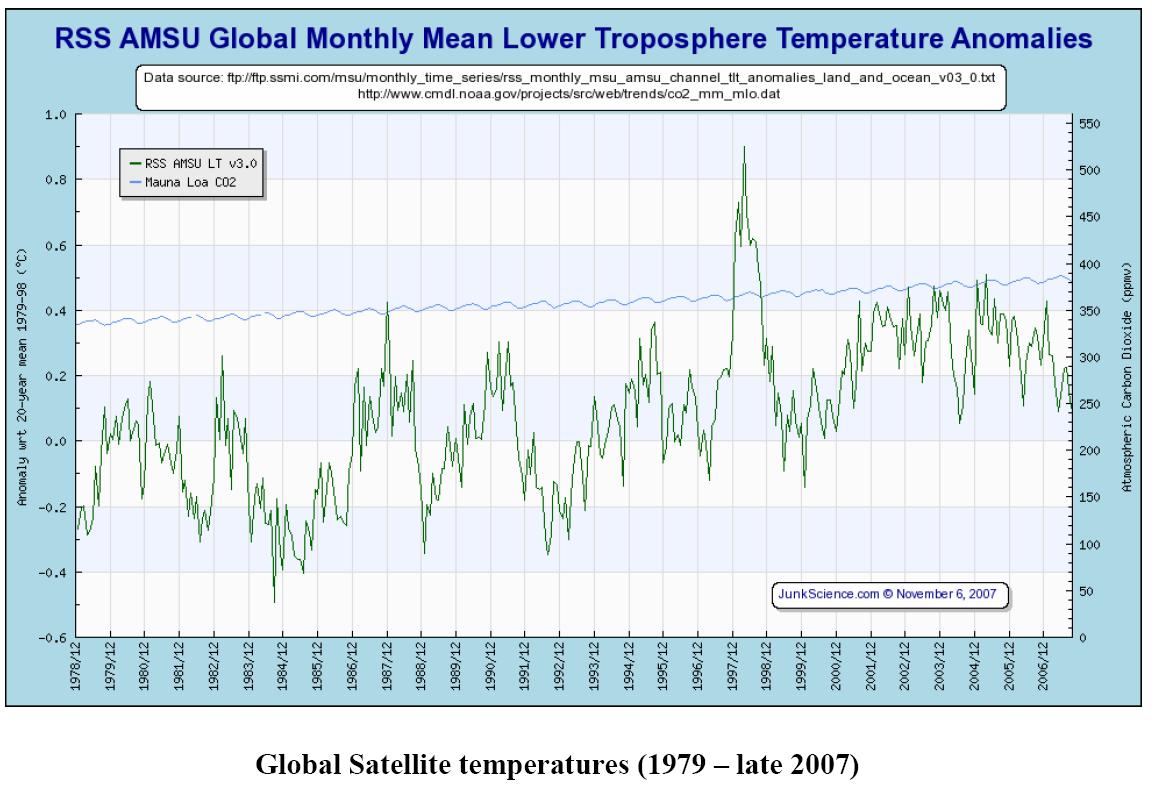
http://www.junkscience.com/MSU_Temps/RSSglobe.html
http://www.junkscience.com/MSU_Temps/RSSNHem.html
http://www.junkscience.com/MSU_Temps/RSSSHem.html
(Gratuitous advice for those whose jobs depend on the idea that carbon emissions cause global warming: Find another job to pay your mortgage and feed your kids!)
Three Stages of Knowledge and the IPCC
Our scientific understanding of global warming has gone through three stages:
- 1985 – 2003. Old ice core data led us strongly suspect that CO2 causes global warming.
- 2003 – 2007. New ice core data eliminated previous reason for suspecting CO2. No evidence to suspect or exonerate CO2.
- From Aug 2007: Know for sure that greenhouse is not causing global warming. CO2 no longer a suspect.
(Nothing Follows)
Friday, 30 November 2007
United Nations states that CO2 emissions are not that dangerous
The United Nations is promoting a CO2 reduction position for the Bali negotiations that allows the world's largest emitter, China, and sometime in the not so distant future top emitter, India, off the economy-limiting hook.
In pushing this position the UN demonstrates that emitting CO2 is, in fact, not dangerous. Why else would they not impose the same requirement on all countries?
Substitute CO2 emissions for mercury or lead being pumped into rivers and the ocean. Does it make sense to allow China and India, or any other country, a position in which toxic waste is pumped willy nilly into the water system?
Of course not.
Obviously, emitting CO2 can't be that bad...
In pushing this position the UN demonstrates that emitting CO2 is, in fact, not dangerous. Why else would they not impose the same requirement on all countries?
Substitute CO2 emissions for mercury or lead being pumped into rivers and the ocean. Does it make sense to allow China and India, or any other country, a position in which toxic waste is pumped willy nilly into the water system?
Of course not.
Obviously, emitting CO2 can't be that bad...
China and India should be spared the full burden of fighting climate change, the United Nations said on Tuesday in an agenda-setting report published just days ahead of an intergovernmental conference to agree to a successor to the Kyoto protocols.
The report of the UN Development Programme recommends that countries such as China and India should be required to reduce their emissions by only 20 per cent by 2050, while the rich industrialised countries shoulder a cut of 80 per cent.
The report will provide ammunition for developing countries wishing to avoid adopting stringent targets on emissions. China, India and others have argued that rich countries should carry more responsibility for the climate because most of the stock of greenhouse gases in the atmosphere came from the growth of their industry.
But the White House made it clear at international meetings on climate change in September that it would not sign up to any agreement that did not include China and the other developing nations going through rapid industrialisation.
Heated discussions over the share of the burden that each country should take for cutting emissions are likely to be the main focus of UN talks on climate change beginning next week in Bali, Indonesia. The talks, the most important since the Kyoto protocol was drafted in 1997, will mark the first negotiations on a potential successor to the treaty, the main provisions of which expire in 2012.
The report estimates that the world needs to spend about 1.6 per cent of gross domestic product each year until 2030 in order to prevent emissions rising to dangerous levels. Developed countries should aim to cut their emissions by 30 per cent by 2020, the UNDP report said.
In a sign of the scale of the task facing ministers at Bali the report also risked opening old wounds by questioning whether the carbon-trading system established at Kyoto was less effective at reducing emissions than a straightforward carbon tax – such as the one proposed on Tuesday by Nicolas Sarkozy, the French president, in Beijing.
Kevin Watkins, lead author of the report, said: “Cap-and-trade is not particularly working. We need to develop the strategy into a carbon tax.”
Emissions trading finally started under the Kyoto protocol in 2005, and last year the market was worth about $30bn, according to the World Bank. Most of the transactions took place under the European Union’s emissions trading system, which was designed to help EU member states meet their commitments to cut emissions under the protocol.
Mr Watkins told the Financial Times: “If the rich countries can cut emissions by 80 per cent we have a 50:50 chance of [limiting] temperature rises to 2 degrees Celsius above pre-industrial levels [which scientists say is the limit of safety].”
The UN’s report came as internet search company Google supplied fresh evidence of investor enthusiasm for low-carbon technology by saying that it would branch out into renewable energy.
Thursday, 29 November 2007
Christmas greetings - a powerful example of the influence of the cultural left
There are few more powerful examples of the influence of the cultural left than the replacement of "Merry Christmas" with "Happy Holidays" and "Seasons Greetings". Ostensibly it's to ensure that people from minority religions are not offended. In reality it's simply an attack on Christianity and Judeo-Christian values.
When Muslims in Western countries demand concession due to cultural sensitivities they know they do so in an environment in which they enjoy the support of leftist institutions including the media, university, advocacy groups and political parties.
Examples of concessions made on cultural and religious grounds include:
When a Westerner travels to, let's use an extreme example to make the point, Saudi Arabia then should the Saudis allow women to drive, wear what they like and not having everyone pray towards Mecca five times a day because it's likely to offend other cultures?
Of course not, it's ridiculous, and proves the moral bankruptcy of the self-defined cultural elites whose agenda is simply to subvert Western cultural values in order to impose one-world socialism.
From a recent Rasmussen Reports poll:
When the left talks about a Culture War who is it that is doing the attacking and who is it that is doing the defending?
(Nothing follows)
When Muslims in Western countries demand concession due to cultural sensitivities they know they do so in an environment in which they enjoy the support of leftist institutions including the media, university, advocacy groups and political parties.
Examples of concessions made on cultural and religious grounds include:
- Replacement of "Merry Christmas" etc with non-aligned terms
- Footbaths for Muslims in various universities
- Support for Muslim taxi drivers to not have to pick up people with alcohol, guide dogs etc
- Halal menus at various education institutions, which have replaced normal menus
- Realignment of toilets in Britain's prisons so that they don't face Mecca (one wonders which way toilets in Mecca face)
- Introduction by banks of Sharia-compliant loans
- Redefinition of racism to include a non-race - Islam
When a Westerner travels to, let's use an extreme example to make the point, Saudi Arabia then should the Saudis allow women to drive, wear what they like and not having everyone pray towards Mecca five times a day because it's likely to offend other cultures?
Of course not, it's ridiculous, and proves the moral bankruptcy of the self-defined cultural elites whose agenda is simply to subvert Western cultural values in order to impose one-world socialism.
From a recent Rasmussen Reports poll:
As the holiday season begins, 67% of American adults like stores to use the phrase “Merry Christmas” in their seasonal advertising rather than “Happy Holidays.” A Rasmussen Reports national telephone survey found that just 26% prefer the Happy Holidays line.Why is it that when two-thirds of the population supports retaining a cultural institution their wishes are completely discounted in the name of cultural equivalence?
There is no gender gap on this question and few demographic differences. From a politically partisan perspective, 88% of Republicans prefer “Merry Christmas” while just 57% of Democrats favor the saying.
Heading into Thanksgiving week, only 27% say they have begun their Christmas or holiday shopping . Consumer confidence among American consumers has been sliding in recent months, giving retailers a cloudy profit forecast in 2007. Most Americans say they plan to spend less on holiday gifts this year. Rasmussen Reports will be updating those figures throughout the holiday season.
Meanwhile, 57% of respondents say they will attend a Christian service on Christmas Eve or Christmas Day this year. A little less than one-third (30%) won’t go to a special service. Women are more likely to attend a Christmas service than men.
When the left talks about a Culture War who is it that is doing the attacking and who is it that is doing the defending?
(Nothing follows)
Wednesday, 28 November 2007
Phoning overseas in North Korea earns you the death penalty
The concentration camp known as North Korea demonstrates its terrific respect for human rights, as codified in the United Nations' Charter.
The blathering multiculturalists who tell us that all cultures are equal and that we have to respect others' values are quiet when North Koreans execute people for making overseas phone calls but if foreigners ever come to Australia then the same group noisily protests that it's a woman's 'right' to wear the veil or dress up like an organic mailbox by donning a full burqa.
(Nothing Follows)
The blathering multiculturalists who tell us that all cultures are equal and that we have to respect others' values are quiet when North Koreans execute people for making overseas phone calls but if foreigners ever come to Australia then the same group noisily protests that it's a woman's 'right' to wear the veil or dress up like an organic mailbox by donning a full burqa.
A North Korean factory chief was executed by a firing squad in front of a stadium of 150,000 people after being accused of making international phone calls, an aid group reports.So what caused the stampede? Ironically, more people were killed exiting the event than were actually being executed in the first place.
The man had been caught calling overseas on 13 phones he had installed and hidden away in a factory basement, the South Korean aid agency Good Friends said in a report on the North's human rights.
A massive crowd of 150,000 filled a stadium and watched the man die.
Despite an overall decline since 2000, public executions have recently been on the increase and officials accused of drug smuggling, embezzlement and other crimes are the main targets.
In the same incident, six people were crushed to death and 34 others were injured as people stampeded out of the stadium.
Most North Koreans are banished from communicating with the outside world because of the country's regime that seeks to prevent any possibility of challenge to leader Kim Jong Il.No wonder the left doesn't make much noise. "...control society..." is what they're all about and they all have a totalitarian streak a mile wide.
The North has carried out four other similar executions to various other factory chiefs in the past few months, the group reported.
"It is aimed at educating (North Koreans) to control society and prevent crimes," Good Friends head Venerable Pomnyun said.
The group has not said how it obtained the information and has given no details of how many executions have taken place.Hands up anyone who thinks that the UN is anything other than morally bankrupt when it treats regimes like North Korea not only with kid gloves but also to handouts of millions of aid dollars - in cash.
The report comes just a week after a UN General Assembly Committee adopted a draft resolution expressing concern at reports of maltreatment and human rights violations in North Korea.
The country has blasted the report, however, saying it is inaccurate and biased.People eat bark off the trees to survive but they don't violate human rights. No worries.
They say they do not violate human rights but the regime has long been accused of imposing the death penalty for political reasons, torturing border-crossers and restricting freedom on expression and religion.
(Nothing Follows)
Tuesday, 27 November 2007
Union gold means union rules
Having paid millions of dollars to ensure a Labor win in last Saturday's Australian election, union bosses are already looking for payback in the form very favourable, pro-union industrial relations changes.
This is a real issue for Kevin Rudd, as the resulting workforce inflexibility will both severely restrict Australia's ability to compete on the world stage and lead to extremely difficult circumstances for Australian families should there be a world economic downturn in the same way that Bob Hawke's union Accord caused so much misery during the 'recession we had to have'.
If Rudd can keep the unions from wrecking things, which Labor's pre-election IR policies would achieve, then Australia should continue to prosper.
It will be a good test of his leadership.
This is a real issue for Kevin Rudd, as the resulting workforce inflexibility will both severely restrict Australia's ability to compete on the world stage and lead to extremely difficult circumstances for Australian families should there be a world economic downturn in the same way that Bob Hawke's union Accord caused so much misery during the 'recession we had to have'.
If Rudd can keep the unions from wrecking things, which Labor's pre-election IR policies would achieve, then Australia should continue to prosper.
It will be a good test of his leadership.
THE ACTU has claimed credit for snaring 24 marginal Coalition seats for Labor in Saturday's federal election after a campaign that targeted at least 240,000 union members.
The boast by Australian Council of Trade Unions president Sharan Burrow yesterday was a strong reminder to Kevin Rudd that unions expect full restoration of rights, such as collective bargaining, as a reward for theirsupport.
Ms Burrow said the ACTU's battle plan in 25 marginal seats, including a computer program to recruit members to help in the fight, was largely responsible for Labor's historic win.
Her comments came amid the revelation that unions planned to continue their fight if necessary, this time against Labor, with a million-dollar "war chest".
Unions NSW secretary John Robertson, critical of the prime minister-elect for not recognising the union role in Labor's victory, told The Australian: "We always said we were going to keep the campaign going after the election. One reason we've seen the government pass such extreme laws is that people were not organised in workplaces, and we're never going to let that happen again."
Mr Robertson voiced his frustration with Labor in July for watering down its industrial relations policy, telling supporters he would "pull Kevin Rudd on once he's prime minister".
Mr Rudd, who told Mr Robertson to "take a cold shower" in July, yesterday rejected the NSW union chief's push to have Labor abolish the Howard government's Australian Workplace Agreements retrospectively.
The Labor leader said the party's revamped industrial relations laws would be a priority, but said: "Mr Robertson is wrong. We will adhere to the implementation agenda of our industrial relations policy as outlined during the election."
National Union of Workers NSW chief Derrick Belan said Labor could deal with many changes immediately by regulation, and not wait for legislation to be introduced into parliament next year. "(Incoming workplace relations minister) Julia (Gillard) should deal with it immediately," Mr Belan said.
"Workers backed them and they should keep their promise."
Mr Belan was also critical of ACTU leaders Ms Burrow and Jeff Lawrence for going soft on Labor by accepting a "step-by-step approach" to changes.
"That's not an unexpected answer from those two," he said. "I believe they're both on their way to parliament."
Ms Burrow said the ACTU believed its campaign made a big difference to how people voted.
"Clearly the impact was deeper in those seats where we had concerted visibility for up to two years." She said eight out of 10 people who voted Labor said industrial relations was the number one issue in exit polls.
"Even the government is acknowledging that Work Choices was their downfall."
Dean Mighell, the outspoken leader of the Electrical Trades Union in Victoria, said he had "no confidence" in Ms Gillard to address union concerns in Labor legislation.
"I think she's got to win the trust of people who supported her for a long, long time, who might have turned a blind eye to some of the less union-friendly comments she made during the election campaign, and hoped she remembers where she came from and all the people who helped her to get to where she is," he said.
Monday, 26 November 2007
Fight climate change OR stay competitive - the two are mutually exclusive
A good article in The Independent by Dominic Lawson - Fight climate change? Or stay competitive? I'm afraid these two aims are incompatible - demonstrates exactly how (especially) European politicians talk out of both sides of their mouths on the issue of climate change. They know that actually achieving stated targets will pretty much destroy their countries' economies (which will have a side effect of wrecking the environment as society breaks down) so talk about tough targets while having no desire to see them reached.
Isn't politics wonderful? Within days of Gordon Brown's address to the conservation group WWF, in which he pledged eye-wateringly tough reductions in British emissions of Co2, the Government has announced its support for the construction of a third runway at Heathrow Airport. "This time he really gets it," Greenpeace's executive director had enthused after the Prime Minister's "Let's save the polar bear" speech. Yesterday, following the Transport Secretary's endorsement of BAA's expansion plans, Greenpeace was back to its default position, spitting ecological tacks.
You might think this is a case of the left hand not knowing what the right hand is doing (or possibly the left hand not knowing what the left hand is doing) especially given the Government's growing reputation for administrative chaos. In fact it is entirely deliberate. The Government both wants to claim "leadership in the fight against climate change" while at the same time it – quite understandably– does not want to do anything which might reduce this country's international competitiveness. It knows that these two objectives are incompatible – very well, then: it will contradict itself.
Gordon Brown's commitment to the most stringent reductions in C02 emissions yet announced by a British Prime Minister follows exactly the path set by his predecessor. Mr Blair would, with a great moral fanfare, pledge this nation to achieve some carbon emission target. Then, when it became completely clear that we were not on track to meet it, he would announce – with equal confidence and certainty – not an easier target but an even tougher one than that which we were failing to achieve.
The civil servants who live in the real world of facts and actually have to devise the practical policies to meet these political flourishes have become increasingly panicky. A month ago there was a leak of an especially desperate memo in which officials warned that the previous Prime Minister's commitment to produce 20 per cent of our energy from renewable sources by 2020 was facing "severe practical difficulties".
As we know, that is senior civil servant speak for "this will be absolutely impossible." One of the memos rather plaintively pointed out that if we admitted this publicly and tried to advocate a general lowering of such targets internationally, there would be "a potentially significant cost in terms of reduced climate change leadership".
Here we see the absurd grandiosity of our global ambitions, partly a legacy of Tony Blair's messianic approach, but which is to some extent a characteristic of the British political class as a whole. More than half a century since the collapse of the British Empire, our leaders still seem to think that what we do or say is as important in the eyes of the rest of the world as it was when we really did rule the waves. It is a grotesque vanity, economically as well as politically.
It has been written often enough that any likely reduction in Co2 emissions from our own generation of electricity is not just sub-microscopic in terms of any measurable effect on the climate: the People's Republic of China is now opening two new coal-fired power stations every week. Real "climate change leadership" would be developing "clean coal" technology and selling it to the Chinese – but for some reason that does not fascinate politicians in the way that targets do. It is insufficiently heroic.
We can see the same national self-obsession in the debate over the environmental consequences of opening a third runway at Heathrow: last year China announced plans to expand 73 of its airports and build 42 new ones. Yes, the British government could demonstrate "increased climate change leadership" by blocking BAA's plans to build another runway at Heathrow. Does anyone seriously imagine that the consequence of further congestion and delays will be something other than a transfer of traffic from that airport to others in the immediate vicinity, such as Charles de Gaulle, which already has much more capacity?
For those on the provisional wing of the British environmental movement, arguments about a loss of business to other countries are irrelevant. They would insist that this complaint makes no more sense than saying that it's necessary to sell arms to unpleasant dictatorships because if we don't, other countries will, to the benefit of their own economies.
If, like George Monbiot, you regard flying as morally equivalent to "child abuse", then, yes, the executives of BAA should be thrown in jail ( after a fair show trial, of course) and never be let out. As for any recession deriving from a closing down of Heathrow – pah! A recession would be a good thing, since it would lead to further reductions in Co2 emissions.
I accept that there will be many sensible people living in the area around the Heathrow Terminals who will not welcome the increase in planes taking off and landing. On the other hand, there has been an aerodrome at Heathrow since the 1930s and the first Terminal was opened by the Queen in 1955: that is to say, there are unlikely to be many home-owners living in the Heathrow area who bought under the impression that he or she would enjoy peace and quiet. Doubtless the property prices there reflect that fact.
Anyway, why worry about airports when we are going to ban the plastic bag? That, you will recall, was the "eye-catching initiative" within Mr Brown's WWF speech. It was artfully designed to capture the headlines in the popular press, and duly did so. The Prime Minister declared that we should "eliminate single-use plastic bags altogether in favour of more sustainable alternatives." Perhaps, since Mr Brown argued that fighting climate change was the political challenge for the younger generation, students should already have been marching on Whitehall with placards declaring "Ban the Bag."
The only problem with that is that plastic bags, though undeniably irritating when left lying around, are essentially the by-product, rather than the cause, of fossil fuel generation. Approximately 98 per cent of every barrel of oil, once refined, is consumed as petrol or diesel. If the remaining two per cent of naphtha was not used for packaging, it would almost certainly be flared off – which is pure waste.
Paper bags have the reputation of being environmentally sounder, but I don't see how this can be justified. They require significantly more space in landfill, being much less compressible – and don't they come from trees, which we are meant to be preserving as capturers of Co2? Besides, if the plastic bag is to be banned, what are we going to use to line our rubbish bins? We need to know the answer to such important questions, Prime Minister, before we allow you to put us forward as the saviours of the planet.
Sunday, 25 November 2007
Sunday night Aussie rock
Australia has a new federal government and that gives the opportunity to post some Aussie songs by activist left wing bands and performers. There are a heap more of those than conservative bands, of course, so I'll probably miss a big hit from the following short list. Naturally, there has to be an entry from Midnight Oil, which featured our minister for the environment in waiting, Peter Garrett, on vocals.
Goanna - Solid Rock
Redgum - I Was Only Nineteen
Midnight Oil - Hercules
The Whitlams - No Aphrodisiac
(Nothing Follows)
Goanna - Solid Rock
Redgum - I Was Only Nineteen
Midnight Oil - Hercules
The Whitlams - No Aphrodisiac
(Nothing Follows)
Saturday, 24 November 2007
Congratulations to the Australian Labor Party
Congratulations to the Australian Labor Party for winning the Australian Federal Election.
The seat count looks something like:
Labor: 84
Coalition: 64
Independent: 2
After 11 years out of power Labor supporters can now spend the next few days whooping it up and having a good time, as they deserve to do and they'll be absolutely loving the fact that it looks like they've knocked off the Prime Minister in his seat of Bennelong.
As discussed yesterday, Labor has run an absolutely brilliant campaign compared to the Coalition's ramshackle, feckless effort.
If Labor can match the outgoing Coalition government's record then Australia will continue to prosper.
I wish them all the best in this endeavour.
(Nothing Follows)
The seat count looks something like:
Labor: 84
Coalition: 64
Independent: 2
After 11 years out of power Labor supporters can now spend the next few days whooping it up and having a good time, as they deserve to do and they'll be absolutely loving the fact that it looks like they've knocked off the Prime Minister in his seat of Bennelong.
As discussed yesterday, Labor has run an absolutely brilliant campaign compared to the Coalition's ramshackle, feckless effort.
If Labor can match the outgoing Coalition government's record then Australia will continue to prosper.
I wish them all the best in this endeavour.
(Nothing Follows)
Aussie election - FINAL betting market info
Betting is now closed on the Australian federal election and according to all of the markets the opposition Labor Party is headed for victory.
Here's the final graph of the market over the course of the election campaign:

Coalition: $3.58 - Labor $1.31
The final bookies' market making up the composite graph above is:

You can see how the market has gone against the Coalition since their early-campaign mini recovery.
Over the last 7-10 days the seat by seat betting at Portlandbet has moved in Labor's favour with the following being the final prediction:
(Nothing Follows)
Here's the final graph of the market over the course of the election campaign:

Coalition: $3.58 - Labor $1.31
The final bookies' market making up the composite graph above is:

You can see how the market has gone against the Coalition since their early-campaign mini recovery.
Over the last 7-10 days the seat by seat betting at Portlandbet has moved in Labor's favour with the following being the final prediction:
Coalition: 66As soon as possible after the election I'll post a comparison of the outcome of each seat compared to expectation of the seat by seat market.
Labor: 82
Independent: 2
Implied uniform swing: Labor: +5.7%
Implied two party preferred vote: Labor 53.0%
(Nothing Follows)
Coalition to sneak home in Australian election with the help of miners and old folk
Nobody has ever accused me of not being ready to give my opinion on the big issues. This time, I'm really putting my neck on the line by giving the election to the government, as I have since it was called. My seat count is as follows:
There is one parameter that has gone largely unreported in this election cycle - the grey vote. It is my understanding that the old folk stopped answering the phone or opening the door some weeks ago in what is the most polled election in history.
The grey vote tends to go to the Coalition. If it breaks Labor's way then there's no hope of the government being returned.
My calculation is that the grey vote will go with the Coalition.
It's not guaranteed that Labor will pick up any seats in Victoria. If the grey vote goes as predicted then that should be enough to maintain the status quo.
The Coalition may well pick up a seat in WA. Even so, it's very likely that they'll retain their numbers there on the back of the mining boom. Never has the phrase "Go west to make your fortune" been more true.
I still think that Queensland is problematic for Labor and, again, I think it's the grey vote that may do them in. NSW and SA look like being the states where the most damage will be inflicted on the Coalition.
That said, whoever has been running the Labor campaign deserves a hearty congratulations. Never in the history of this country (or any other, I imagine) has a campaign worked so well by hitting the targets that need hitting, dodging the issues that needed dodging and presenting a friendly, non-threatening face to the electorate.
On the other side of the aisle, a huge brickbat for the team running the Coalition election campaign. It's as if they've hired Gary Gray to give them advice. If the polls do stand up and they're defeated then they'll have nobody to blame but themselves.
Coalition 76All of the polls show a Labor victory with only the Galaxy poll giving the government a chance. That's handy, as Galaxy has proved itself to be the most reliable of the forecasters. On the flip side, the betting markets always tend to prove accurate - with the famous exception of the Kennett government's loss - and Portlandbet's seat by seat market has it Labor 82, Coalition 66, Independent 2.
Labor 72
Independent 2
There is one parameter that has gone largely unreported in this election cycle - the grey vote. It is my understanding that the old folk stopped answering the phone or opening the door some weeks ago in what is the most polled election in history.
The grey vote tends to go to the Coalition. If it breaks Labor's way then there's no hope of the government being returned.
My calculation is that the grey vote will go with the Coalition.
It's not guaranteed that Labor will pick up any seats in Victoria. If the grey vote goes as predicted then that should be enough to maintain the status quo.
The Coalition may well pick up a seat in WA. Even so, it's very likely that they'll retain their numbers there on the back of the mining boom. Never has the phrase "Go west to make your fortune" been more true.
I still think that Queensland is problematic for Labor and, again, I think it's the grey vote that may do them in. NSW and SA look like being the states where the most damage will be inflicted on the Coalition.
That said, whoever has been running the Labor campaign deserves a hearty congratulations. Never in the history of this country (or any other, I imagine) has a campaign worked so well by hitting the targets that need hitting, dodging the issues that needed dodging and presenting a friendly, non-threatening face to the electorate.
On the other side of the aisle, a huge brickbat for the team running the Coalition election campaign. It's as if they've hired Gary Gray to give them advice. If the polls do stand up and they're defeated then they'll have nobody to blame but themselves.
Subscribe to:
Posts (Atom)